
Honeycomb · Animals & breeding
Albino Zuma
Zuma Family · Breeding
Not found naturally.
- Class
- Amphibia
- Order
- Salamander
- Family
- Zuma
Description
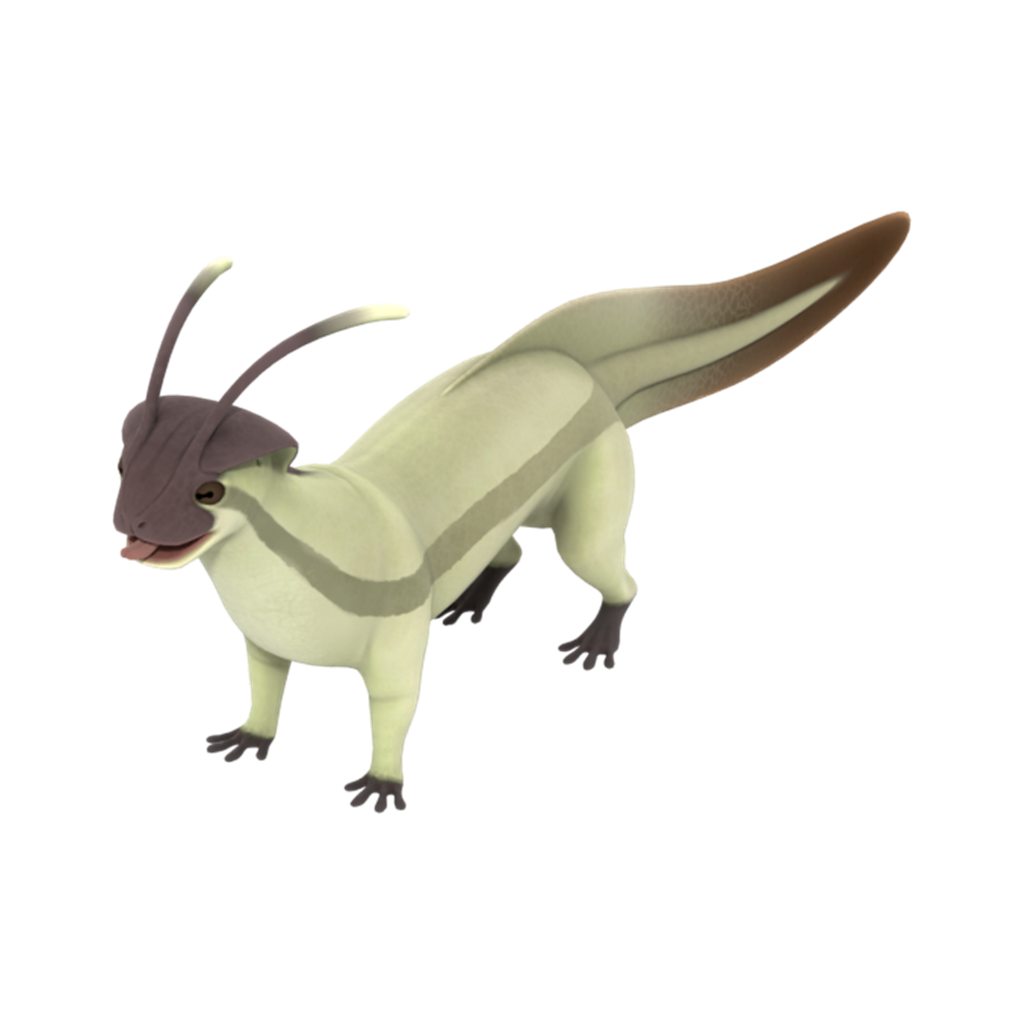
The Albino Zuma is a small-sized amphibian with a smooth, elongated body shaded in pale cream and off-white tones. Its back is marked with faint beige bands that continue along the torso, while its tail darkens toward a soft brown at the tip. It has a rounded head with a wide mouth and alert eyes with a brown sclera, while two long, thin antennae-like appendages extend backward from the top of its head. Its limbs are short but sturdy, ending in delicate digits, and the tail is thick, tapering gently to a rounded tip.
Behaviour
Zumas display a timid type of temperament. They prefer to stay hidden and are easily alarmed, often escaping into cover when disturbed. These creatures can be found close to open water sources in damp, cool environments. They often seek shelter among dense vegetation, beneath mossy rocks, or inside hollowed tree trunks.
Family
Breeding
Building trust
- Cautious
A cautious Zuma vanishes into cover at the first sign of you and will not come out while you wait nearby. Leave a Zuma Snack near its hiding place and move away - it only eats when it believes it is alone.
- Neutral
It stays in the open now instead of bolting for cover. Offer the Zuma Snack from your hand; given directly, it is worth far more than one the animal has to find.
- Warm
A warm Zuma lets you crouch beside it without flinching. Stroke it - touch now earns its trust twice as fast as feeding does.
- Friendly
A friendly Zuma will leave its cover to follow you. Keep it at your side and lead it back to a nest to make the bond permanent.
Family snack
Zuma Snack
Recipe
Family pheromone
Zuma Pheromone Injector
Recipe
- 1× Viscous Secretion
- 1× Green Naga
Artificial nest & breeding
After completing the animal research, you can build an artificial nest for this animal family and house animals that follow you there.
Bring together a male and female from the same family but different species in an artificial nest. Insert the matching family pheromone into the dispenser, then give the animals time and privacy.
Animal camera & research
- Place an animal camera near a natural animal nest.
- Wait until data collection is complete.
- This updates the behaviour and fauna information.
- The research provides the basis for this animal family’s artificial nest.